Undergraduate Program in
Computer Engineering
What is Computer Engineering?
At the moment, mobile technology as the convergence of computer and communication technology (ICT) is growing rapidly. To support such technology development, especially in designing Computer Engineering, the Computer Engineering program is designed to produce the graduates who are able to develop mobile technology.
This program focuses on embedded systems as the main part of mobile devices. The program also prepares the students to be able to design and build computer networks and data communication both in a company and in a mobile format and also design variours digital-technology-based devices.

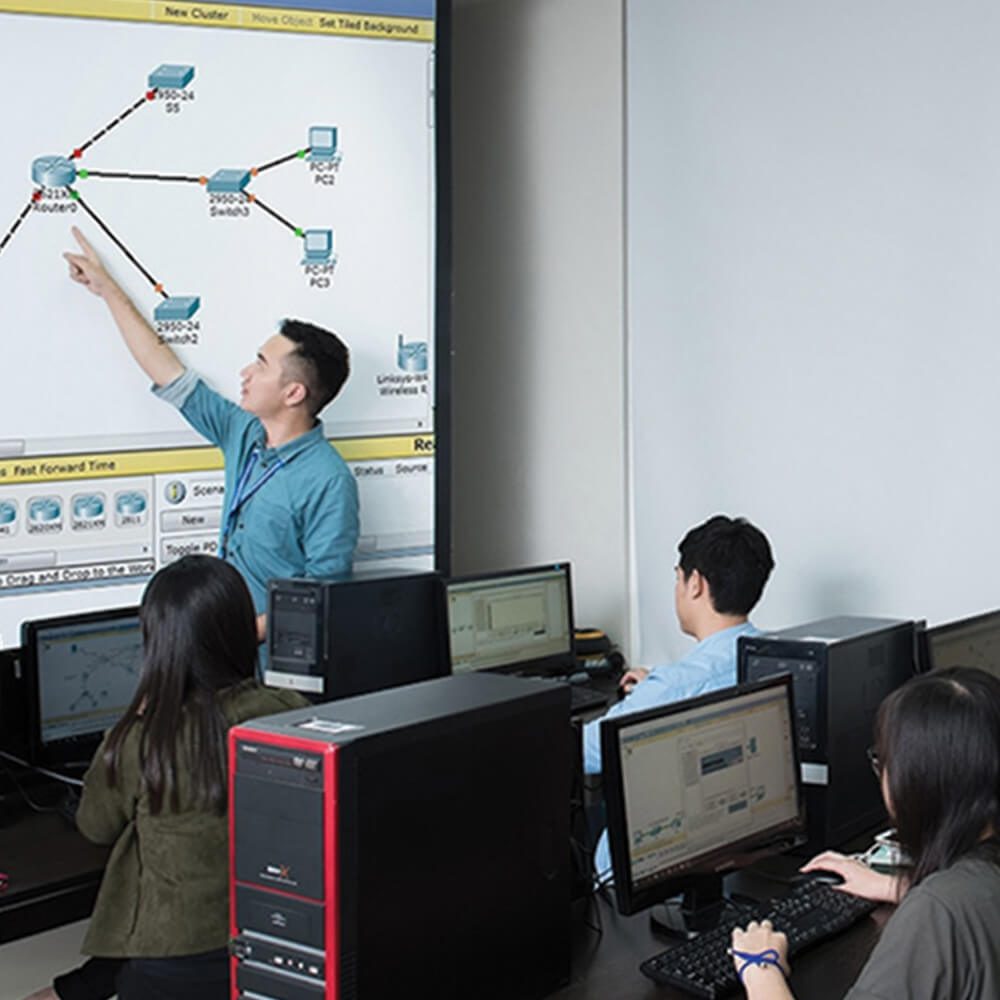
Spesialization in UMN Computer Engineering
- Advanced Database (ORACLE) with two options: Administrator or Developer
- Applied Computer Networking (CISCO)
- Company System and Application (SAP)
- Digital Game Development and Programming
- Certified Ethical Hacker (CEH)
- Internet of Things
- Mobile System Development
FAQ
Why Choose Computer Engineering at UMN?
The Computer Engineering Study Program at Universitas Multimedia Nusantara (UMN) is an excellent choice for prospective students who want to study the integration of hardware and software. The program is designed to equip students with the competencies needed to design, develop, and integrate computing systems that support various industry needs in the digital era.
At Computer Engineering UMN, students not only study theory but also gain practice-oriented learning experiences. The curriculum is designed to follow the latest technological developments, allowing students to explore various fields such as computer systems, embedded systems, Internet of Things (IoT), computer networks, artificial intelligence, cybersecurity, and computing based on smart devices.
The learning process applies Outcome-Based Education (OBE) and Project-Based Learning (PBL) approaches. Through these approaches, students are encouraged to develop solutions to real-world problems through various projects relevant to industry needs. In addition to developing technical competencies, students also develop critical thinking, communication, collaboration, and project management skills that are essential in the workplace.
Computer Engineering UMN students also have opportunities to enrich their experience through internships, research, competitions, professional certifications, and collaborations with various industry partners. These experiences help students understand the direct application of technology while building a portfolio that can serve as an added value after graduation.
One of the advantages of Computer Engineering UMN is its internationally recognized educational quality. The study program has received ASIIN (Accreditation Agency for Study Programmes in Engineering, Informatics, Natural Sciences and Mathematics) accreditation, an international accreditation agency based in Germany. The ASIIN accreditation demonstrates that the curriculum, learning process, teaching staff, and quality assurance system of Computer Engineering UMN meet international standards in engineering and informatics. This recognition provides added value for both students and graduates in facing competition at the global level.
Graduates of Computer Engineering UMN have broad career prospects across various industries that utilize digital technology. Career opportunities include Embedded System Engineer, IoT Engineer, Computer Hardware Engineer, Network Engineer, Cybersecurity Engineer, Software Engineer, AI Engineer, Robotics Engineer, and System Integrator. As digital technology continues to evolve, the demand for Computer Engineering graduates continues to grow across various industries.
With a relevant curriculum, project-based learning, international recognition through ASIIN accreditation, and support from collaborations with industry, the Computer Engineering Study Program at UMN prepares students to become adaptive and innovative graduates who are ready to contribute to technological development at both the national and international levels.
How to Apply to Computer Engineering at UMN?
Prospective students who wish to join the Computer Engineering Study Program at UMN can participate in the new student admission process through the various selection pathways available at UMN. The registration process is conducted online by completing the registration form, submitting the required documents, and completing the selection stages according to the chosen admission pathway.
For information regarding registration schedules, requirements, tuition fees, scholarships, and available admission pathways, prospective students can visit the UMN New Student Admission (PMB) page or contact the UMN admissions team. By obtaining complete information, prospective students can choose the admission pathway that best suits their needs and educational plans.
What Do Students Learn in Computer Engineering at UMN?
The Computer Engineering Study Program at Universitas Multimedia Nusantara (UMN) explores how hardware and software work together in an integrated manner to create various technological solutions. The program is designed to equip students with the knowledge and skills to design, build, develop, and optimize computing systems used across various industries.
In the early stages of the program, students learn the fundamentals of computer science and engineering, such as mathematics, programming, algorithms, data structures, digital electronics, computer architecture, and operating systems. These courses provide a foundation for understanding how a computer system works as a whole, from its hardware to its software.
As students progress through the program, they explore various fields that are central to Computer Engineering. These include embedded systems, Internet of Things (IoT), computer networks, microprocessors and microcontrollers, cybersecurity, artificial intelligence, cloud computing, and the development of smart device-based systems. These subjects are designed to address the evolving needs of industries amid rapid digital transformation.
Learning in Computer Engineering UMN applies Outcome-Based Education (OBE) and Project-Based Learning (PBL) approaches. Through these approaches, students not only study theory but also participate in various projects that challenge them to design and develop technological solutions to real-world problems. These projects help students develop critical thinking, analytical, collaboration, communication, and systematic problem-solving skills.
In addition to classroom activities, students also have opportunities to participate in internships, research, competitions, professional certifications, and collaborations with industry partners. These experiences provide insights into the application of technology in the workplace while helping students build their portfolios before graduation.
Throughout their studies, students also develop various skills needed in the digital era. These include not only technical competencies in computer engineering but also the ability to work in multidisciplinary teams, manage projects, adapt to technological developments, and communicate solutions effectively to various stakeholders.
The Computer Engineering UMN curriculum is also supported by international recognition through ASIIN (Accreditation Agency for Study Programmes in Engineering, Informatics, Natural Sciences and Mathematics) accreditation. This accreditation demonstrates that the quality of the curriculum, learning processes, and quality assurance system of the study program meet international standards in engineering and informatics.
Upon completing their studies, graduates of Computer Engineering UMN are expected to be able to design and develop innovative computing systems according to industry needs. These competencies open opportunities to pursue careers as Embedded System Engineers, IoT Engineers, Computer Hardware Engineers, Network Engineers, Cybersecurity Engineers, AI Engineers, Software Engineers, and various other professionals involved in digital technology development.
Through a relevant curriculum, project-based learning, supporting facilities, and collaboration with industry, the Computer Engineering Study Program at UMN prepares students to become graduates who are ready to face the challenges and opportunities of the digital transformation era.
What Is the Difference Between the Regular Program and International Program in Computer Engineering at UMN?
The Computer Engineering Study Program at Universitas Multimedia Nusantara (UMN) offers two study pathways, namely the Regular Program and the International Program. Both programs share the same goal of equipping students with competencies in computer engineering through a curriculum relevant to technological developments and industry needs. The differences lie in the learning experience, language of instruction, and opportunities to gain academic experience at the international level.
The Regular Program provides a learning experience focused on developing competencies in computer engineering through lectures, practical sessions, and project-based learning. Students study various fields, including programming, computer systems, embedded systems, Internet of Things (IoT), computer networks, artificial intelligence, and cybersecurity. All learning activities are designed to prepare students to face challenges in the workplace and keep pace with technological developments.
Meanwhile, the International Program offers a learning experience with a global perspective. Students take certain courses using English as the language of instruction, enabling them to improve their academic and professional communication skills in an international environment. The program also provides opportunities for students to interact with guest lecturers, international students, and academic partners from various countries.
In addition, students in the International Program have opportunities to participate in various international activities facilitated by UMN, such as student exchange programs, international mobility, academic collaborations with partner universities, and overseas learning experiences in accordance with the applicable program requirements. These experiences help students broaden their perspectives, build international networks, and understand technological developments from a global perspective.
Both the Regular Program and the International Program use a curriculum based on the same learning outcomes. Students from both programs acquire core competencies in Computer Engineering, including the ability to design, develop, and integrate hardware and software to create innovative technological solutions. Outcome-Based Education (OBE) and Project-Based Learning (PBL) approaches are also implemented in both programs so that students gain an applied learning experience oriented toward industry needs.
The choice between the Regular Program and the International Program can be tailored to each prospective student’s academic goals and personal development plans. For students who want to gain an international learning experience, improve their English proficiency, and expand their global network, the International Program can be an appropriate choice. Meanwhile, the Regular Program continues to provide a comprehensive learning experience with a high-quality curriculum that is relevant to industry needs.
Before making a decision, prospective students are encouraged to learn more about the curriculum, tuition fees, and various academic opportunities offered by each program. By understanding the characteristics of both pathways, prospective students can choose the program that best suits their interests, needs, and future career goals.
Do You Need to Be Good at Coding to Study Computer Engineering at UMN?
No. Prospective students do not need to be proficient in coding before entering the Computer Engineering Study Program at Universitas Multimedia Nusantara (UMN). Programming skills will be learned gradually throughout the program, starting from basic concepts to their application in developing various computing systems.
In the early semesters, students will learn the fundamentals of programming, algorithms, and computational logic. These courses are designed to help students understand how to approach and solve problems using technology. Therefore, students who have never learned coding still have the opportunity to follow the courses successfully as long as they are willing to learn and practice.
However, it is important to understand that Computer Engineering is not only about coding. The program combines computer science with electronics engineering, so students will also learn how hardware works, including processors, microcontrollers, sensors, digital circuits, and embedded systems. Students will also learn how hardware and software interact to create systems that can be used in everyday life.
For example, when developing an Internet of Things (IoT) device, students do not only write program code but also learn how sensors collect data, how microcontrollers process information, how devices communicate through networks, and how the system can operate efficiently and securely. In other words, coding is only one part of the technology development process.
In addition to technical skills, Computer Engineering students are also expected to develop logical, analytical, and systematic thinking skills. They will frequently face challenges that require them to analyze problems, determine the most appropriate solutions, and test whether those solutions can be implemented effectively. Therefore, curiosity, attention to detail, and problem-solving skills are often more important than having prior coding experience before entering university.
For prospective students who already have coding experience, this ability can certainly be an advantage. However, students who have never learned programming do not need to worry about falling behind. Many students start from scratch and are able to follow the courses successfully because these skills are developed gradually through learning and practice.
If you are interested in understanding how computers, electronic devices, robotics, Internet of Things (IoT), or smart technologies used in everyday life work, Computer Engineering UMN can be the right choice. The program does not look for prospective students who already know everything from the beginning, but rather those who have a passion for learning, curiosity about technology, and the willingness to continuously develop their skills as the digital world evolves.
What Are the Career Prospects for Computer Engineering Graduates at UMN?
Graduates of the Computer Engineering Study Program at Universitas Multimedia Nusantara (UMN) have broad career prospects as the demand for professionals in digital technology continues to grow. The development of technologies such as Internet of Things (IoT), Artificial Intelligence, embedded systems, cloud computing, and industrial automation has opened up various career opportunities for Computer Engineering graduates across different sectors.
Throughout their studies, students are equipped with competencies in designing, developing, and integrating hardware and software. In addition to understanding computer systems, students also study computer networks, microcontrollers, embedded systems, cybersecurity, and smart technologies that are widely applied in today’s industries. These competencies prepare Computer Engineering graduates at UMN to adapt to continuously evolving technologies.
Graduates of Computer Engineering UMN have opportunities to pursue careers in various fields. Some of the professions they can pursue include Embedded System Engineer, IoT Engineer, Computer Hardware Engineer, Software Engineer, Network Engineer, Cybersecurity Engineer, Robotics Engineer, AI Engineer, System Integrator, and Research and Development (R&D) Engineer. In addition to working for technology companies, graduates can also pursue careers in manufacturing, telecommunications, automotive, healthcare, finance, and government institutions that utilize digital technology.
The quality of Computer Engineering education at UMN has also received international recognition through ASIIN (Accreditation Agency for Study Programmes in Engineering, Informatics, Natural Sciences and Mathematics) accreditation, an international accreditation agency based in Germany. This recognition demonstrates that the curriculum, learning processes, and quality assurance system of the Computer Engineering Study Program at UMN meet international standards in engineering and informatics. ASIIN accreditation provides added value for graduates by demonstrating that the competencies they acquire are aligned with globally recognized educational standards.
The success of Computer Engineering graduates at UMN is also reflected in the careers pursued by its alumni, who have worked at various national and multinational companies. Alumni work in a wide range of fields, from software development and hardware engineering to cybersecurity and the development of solutions based on artificial intelligence and Internet of Things. These experiences demonstrate that Computer Engineering graduates at UMN are capable of competing and contributing across various industries that rely on technology as part of their business processes.
In addition to entering the workforce, graduates also have opportunities to pursue higher education or develop technology-based startups. Their knowledge, analytical skills, and experience in developing technological solutions provide a strong foundation for innovating and creating digital products and services.
With a relevant curriculum, applied learning experiences, recognition through international ASIIN accreditation, and an alumni network whose members have pursued careers across various industries, the Computer Engineering Study Program at UMN prepares graduates to become adaptive and innovative professionals who are ready to face the challenges of technological development at both the national and international levels.
Tabel Akreditasi
| Institution Accreditation |
National Accreditation |
International Accreditation |
 |
 |
 |
ECTS Points Table
| ECTS Points | 146 SKS |
| Education Type | Bachelor Program |
| Duration | 4 years |
| Language | Bahasa Indonesia |
| Bachelor's Degree | Bachelor of Engineering |
Vision & Mission
Vision
To become an outstanding undergraduate Computer Engineering program that produces international-minded graduates who are focus in mobile computing & communication and have entrepreneurial spirit and noble character.
Mission
- To conduct studies with the best technology and curriculum, supported by professional lecturer.
- To conduct research in Computer Systems to promote Science and supported the teaching process.
- To deliver useful society services in Computer Systems to develop industries, government and society.
Career Prospect
- Computer System Engineers/System Developers
- Network Engineers/Administrators
- Software/Hardware Engineers
- Embedded System Engineers
- System Analysts
- Interface Designers
- Research Assistants
- Scholars
- Technopreneurs.
Further Study
Curriculum
The students of Computer Engineering program will be equipped with deep knowledge about computing organizations and architectures, reminder organizations and architectures, Operating Systems (including Linux, Windows, and software basis that works in the operating systems), programming language, Algorithm, Hardware Implementation, Modular Programming in FPGA, Building Device Drivers, Web Development, Distributed Systems.
Entry Requirement
- High school graduate majoring in Science
- SMK graduates majoring in Computer Engineering, Information Engineering, Computer and Network Engineering.
Why Choose UMN’s Computer Engineering?
The Computer Engineering study programme at UMN focuses on equipping students with a wider knowledge of software, hardware, and network infrastructures This ability is crucial in allowing our students to have the necessary bird-eye’s view of any computer systems, to prepare them for the ‘system architect’ role. On the other hand, the students will also have the opportunities to work in a more diverse fields so that they can adapt to the needs of technology development.
In the software side, students will learn to program frontend & backend web applications, mobile applications, as well as programming in “various types” of computers. Students are also introduced to AI with focus on image processing. On the hardware side, students learn basic electronics and how to integrate them into a connected system of multiple computers, that includes both hardware and software. On the network infrastructure side, students will be equipped with skills and knowledge in cloud, server, network, and security.
ECTS Points Table
| ECTS Points | 146 SKS |
| Education Type | Bachelor Program |
| Duration | 4 years |
| Language | Bahasa Indonesia |
| Bachelor's Degree | Bachelor of Engineering |
Career Prospect
- Computer System Engineers/System Developers
- Network Engineers/Administrators
- Software/Hardware Engineers
- Embedded System Engineers
- System Analysts
- Interface Designers
- Research Assistants
- Scholars
- Technopreneurs.
Further Study
Scholarships
Universitas Multimedia Nusantara (UMN) provides scholarship for students with academic, sports and arts achievements in class XI. UMN also welcome high school/vocational school students who have attained medals in the National and International Science Olympics.
As a form of appreciation for the dedication of teachers and employees/staff in educating the nation's children, UMN provides scholarships in the form of reduced tuition fees amounting to 50% for children of teachers/principals and a 30% reduction in tuition fees for children of employees/staff at State/Private High School/Vocational Schools who wish to continue their education at UMN.
For more information click here.
Admission requirements
In general, the admission requirements for the Computer Engineering study programme at UMN are as follows.
Specific aspects | Requirements |
School origin |
|
Emphasised subjects in school report (for non-test channel) | Mathematics, English, Physics, IT or Entrepreneurship |
Written test subjects (for test channels) | Mathematics, English, Logics, Science |
The table below summarizes admission requirements for applicants with different qualifications of high school-equal education, as well as non-Indonesian citizen applicants.
Origin | Additional admission requirement |
National standard - Paket C Exam* | Admitted |
Homeschooling | Take the National standard - Paket C Exam |
Overseas high school | Take the National standard - Paket C Exam Other degree equalization process acknowledged by Ministry of Education |
International applicants | English proficiency, TOEFL (ITP) ≥ 500, or IELTS ≥ 5.5 |
* The policy regarding the Paket C Exam follows the Regulation of the Minister of Education, Culture, Research and Technology of the Republic of Indonesia Number 31 of 2023 concerning Equivalency Tests. Based on the Placement Test Guide, the equivalent subjects are:
- General Group, consisting of Religious Education, Citizenship Education, Indonesian Language, Mathematics, Indonesian History, and English.
- Specialties, may include:
- Mathematics and Natural Sciences, consisting of Mathematics, Biology, Physics and Chemistry
- Social Sciences, consisting of Geography, History, Sociology and Economics
- Language and Culture Sciences, consisting of Indonesian Language and Literature, English Language and Literature, other languages and literature (Arabic, Mandarin, Japanese, Korean, German, French), and Anthropology
- Special Group, consisting of Empowerment and Structured Functional Skills
Each student is assigned an academic advisor (which are also lecturer), and students are required to do at least 3 academic advisory sessions per semester. The academic advisory schedule is set up by appointment between the advisor and the student(s). Topics of discussion may include anything related to the student’s academics but is mainly about course planning.
P.s. Please refer to the academic handbook in MyUMN.
Students are encouraged to find their own company/agency that accepts internship work or utilize the network of companies maintained by UMN’s Career Development Center (CDC). The work should match the focus of the Computer Engineering study programme, which includes broader fields of software, hardware, and infrastructure. Information on internship job vacancies can also be obtained from other students, social media, job fairs, advertisements in print or electronic media.
Should the students find any internship opening, please consult the academic advisor (or the study programme) to ensure the job matches the study programme requirements.
P.s. Please refer to the internship guidebook in MyUMN.
To complete the Bachelor’s Degree (S-1) of Computer Engineering programme at Universitas Multimedia Nusantara, students are given one semester to work on a final project. Students must submit a final project proposal by the 2nd week of the semester. During the semester duration, students must present and defend a final project to the examining board.
Students work on the final project individually and is guided by one or two supervisors (lecturers). Assignment of supervisors are determined by the study programme, but students are allowed to request for specific supervisors if an agreement has been reached between the supervisors and the student beforehand.
P.s. Please refer to the final project guidebook in MyUMN.
No announcement.
Curriculum Structure
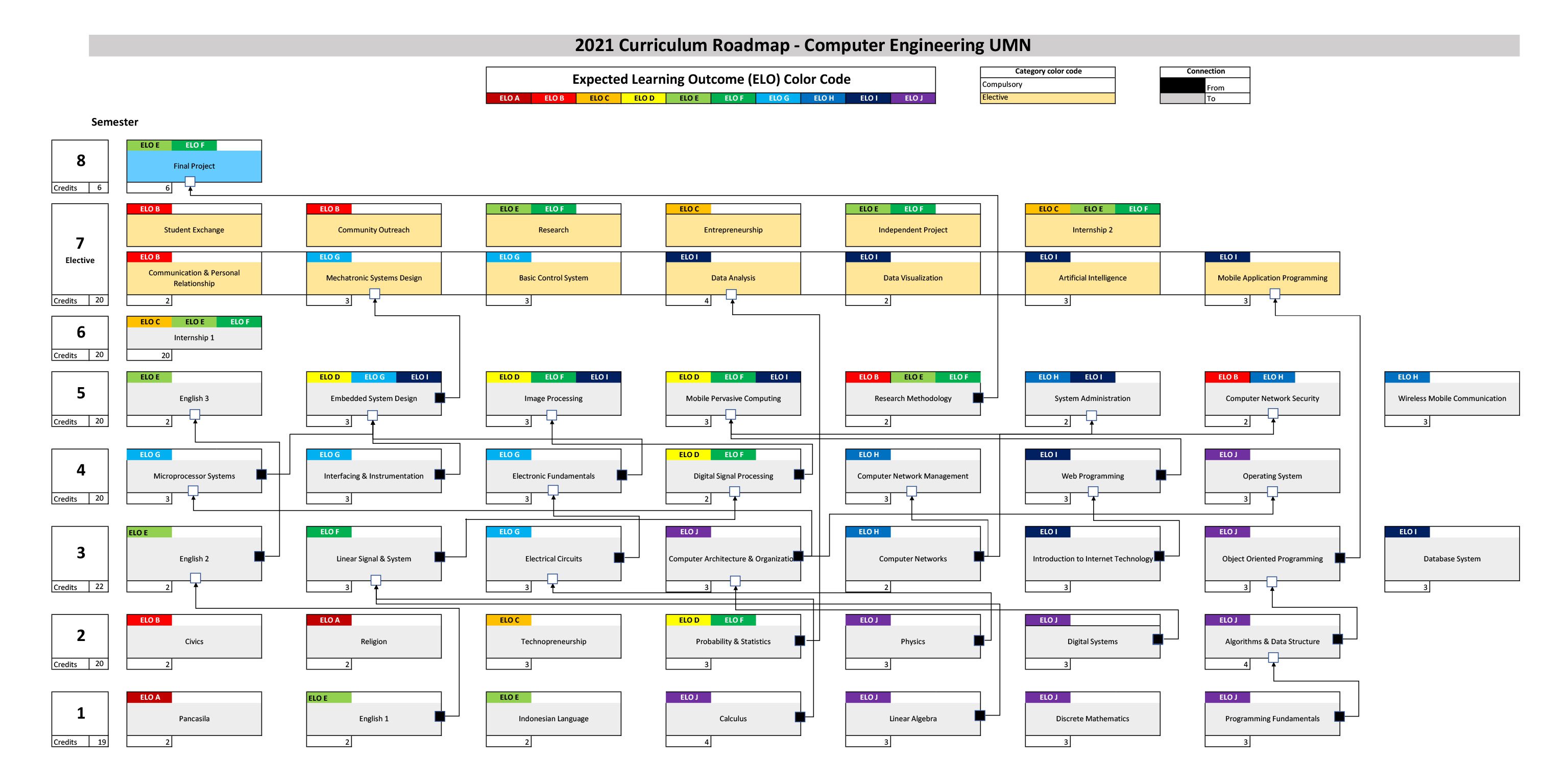
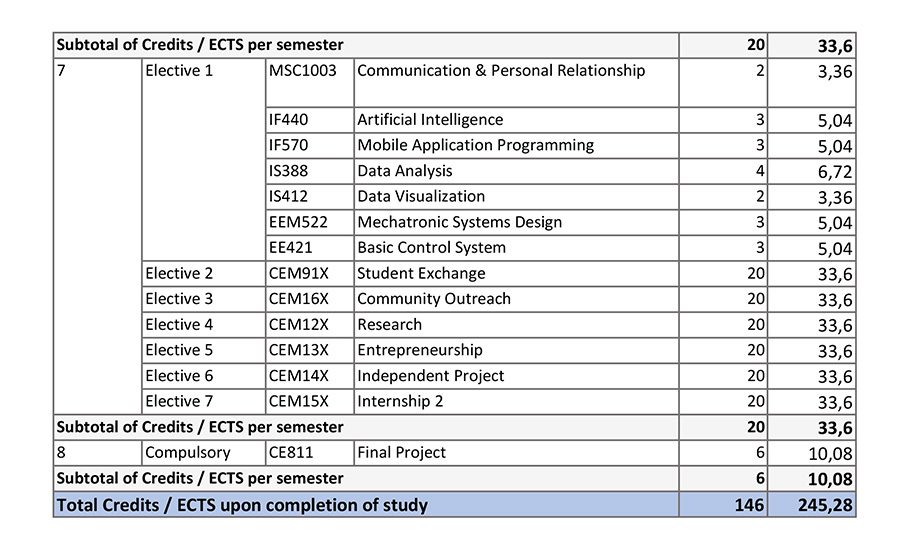
Our curriculum ensure that students are equipped with the core knowledge in computer engineering disciplines in semester 1-5, followed by a compulsory internship in the 6th semester. In the 7th semester, students are allowed to choose from various activities to further focus on studying certain areas. The offered activities are elective courses, student exchange, community outreach, research, entrepreneurship, independent project (competitions), or internship.
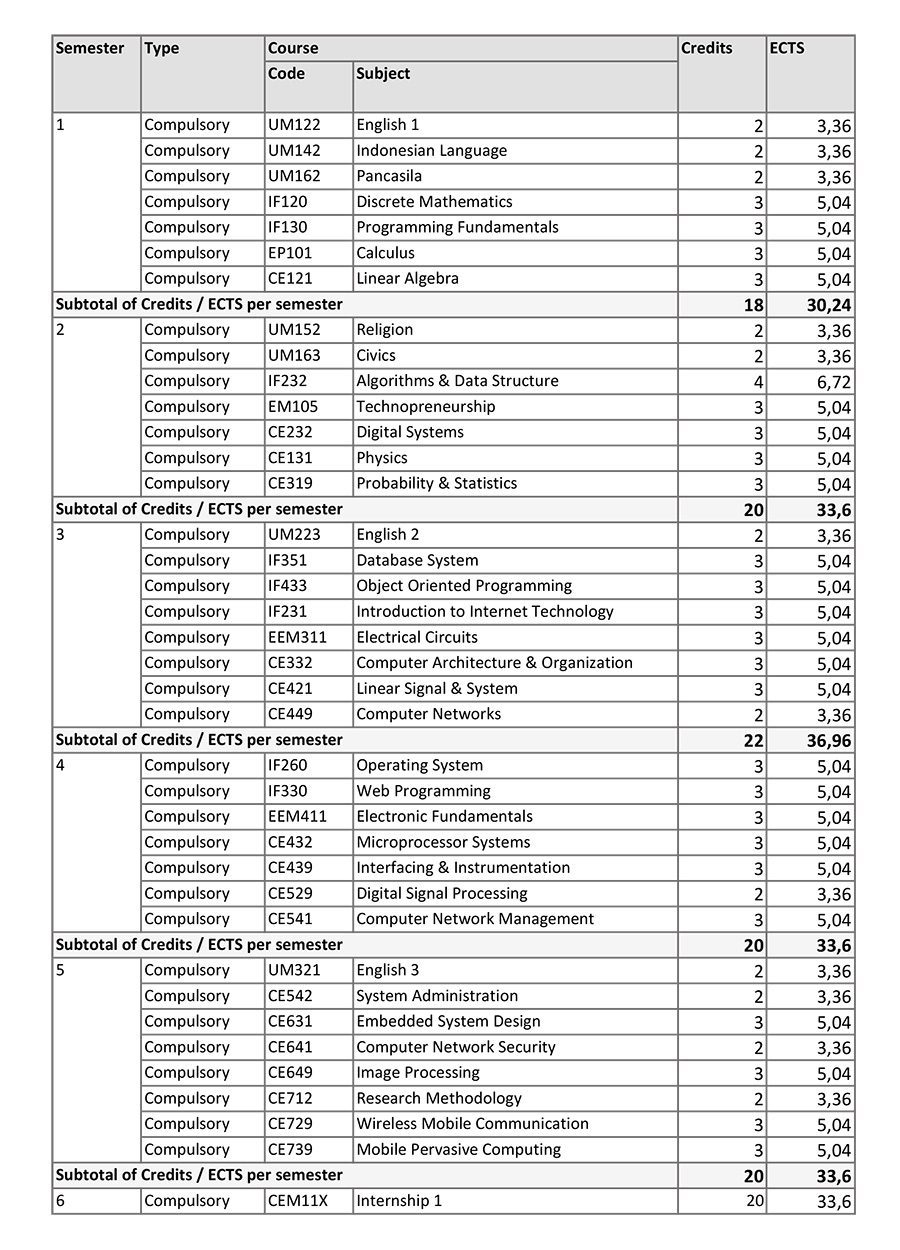
We structured our curriculum to enable students to complete the study and achieve the ELOs in 7-8 semesters (146 credit hours, equals to 245.28 ECTS).
| Sem | Credits / ECTS | Description |
| 1-2 | 38 credits / 63.84 ECTS | Mandatory (Basic science & computer subjects) Students take in-programme classes that establish their basic science & computer principles. Even mix between general subjects and basic science & computer. Students are also introduced to entrepreneurship. All subjects are theoretical except for one subject of programming basics. |
| 3-4 | 42 credits / 70.56 ECTS | Mandatory (Software & hardware subjects) Students learn a mix of software and hardware subjects, through theoretical and practical (guided by lab modules) courses. An even mix of subjects in software and hardware / embedded systems. |
| 5 | 20 credits / 33.60 ECTS | Mandatory (Computer Engineering core subjects) Students deepen their understanding of the programme’s main competencies through theoretical and project-based courses. Subjects focus on core competencies of embedded systems, infrastructure, and tech integration. Through project-based courses, students demonstrate both hard skills and problem-solving skills by developing technology-based solutions for certain problems. |
| 6 | 20 credits / 33.60 ECTS | Internship Students participate in a semester-long full-time internship to equip them with necessary experience of the professional world. The company and the job role applied to by the students is screened by the study programme. That is, the job role should require skills related to ELO G/H/I (our technical and applicative ELOs). |
| 7 | 20 credits / 33.60 ECTS | Elective (Courses / Mobility Programmes) The available activities are Research, Community Outreach, Internship, Entrepreneurship, Independent projects, and Student exchange. Students may also choose from externally organised activities. |
| 8 | 6 credits / 10.08 ECTS | Final project Students work on a final project to demonstrate their understanding of basic principles, computer technology, and research. |
Curriculum Roadmap
Course Lists





To support the learning process, umn provided a complete and sophisticated college facility, according to industrial standards. Through the existence of the facility, students have been invited to be close to the industrial world since sitting in college and to have competence that matches the needs of the industry. That way, it will make it easier for umn students to find jobs, even before graduation.

A laboratory equipped with technological tools that can help students hold discussions and design concepts. […]

UMN also facilitates students to earn certificates before graduating. Viewing through an international scale, UMN […]
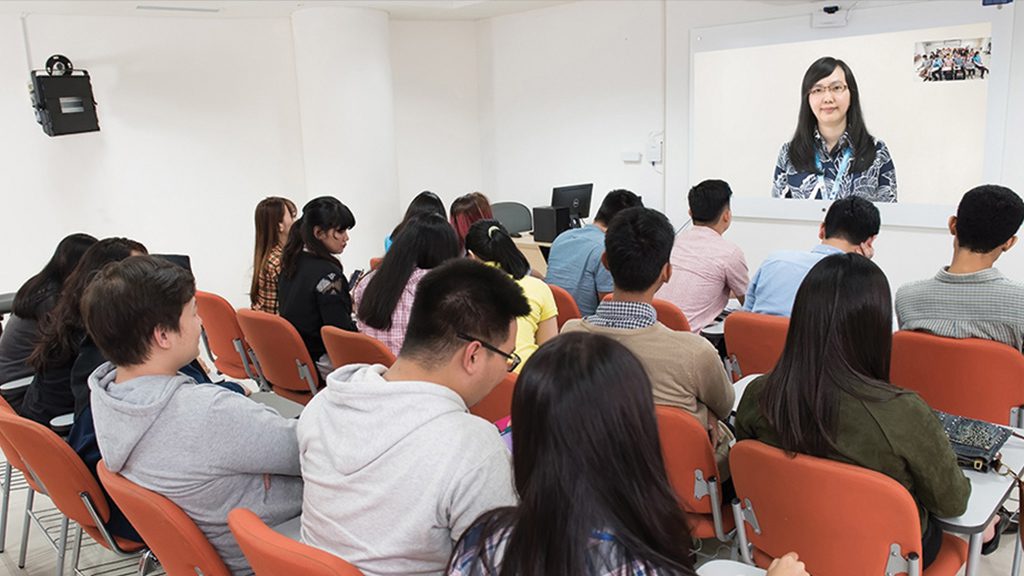
UMN is committed to advancing digital and online learning as an integral part of its […]

This modern theater hall has a capacity of up to 200 people. This room is […]

With the extent of modern interior designs, tens of thousands of local and international reading […]

Every UMN student holds an account to log in to the MYUMN application that provides […]

UMN’s Wi-Fi has a free flow system where UMN students are not charged with cellular […]

By using an official device from Huawei, this laboratory is used by students to study […]
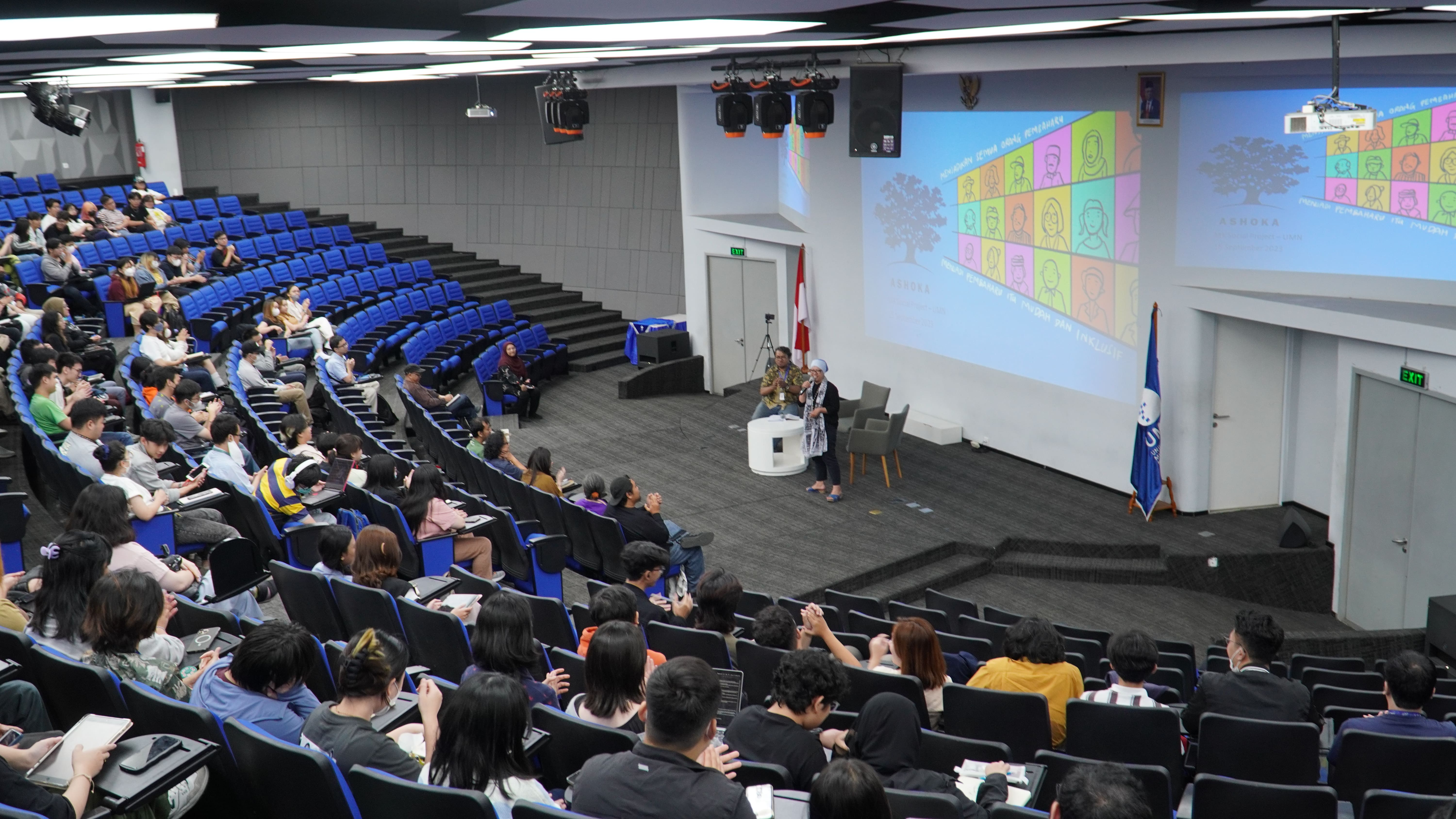
With a larger capacity compared to the other halls, the Lecture Theatre can accommodate up […]

UMN became the first campus established by Kompas Corner. Here, UMN students can access information […]
Extracurricular Student Activities
In order to help students explore and develop their non-academic potentials, UMN also provides a variety of extra-curricular activities for students which is locally called UKM, Student Activity Unit.

Student who are Nature Lovers in University Multimedia Nusantara can join and participate in UMN’s […]

Ultima Sonora is the Universitas Multimedia Nusantara Choir ensemble which has been established since 2007. […]

UMN Symphony Orchestra (USO), is one of the arts and culture UKM at UMN. As […]

Traditional Music and Dance or familiarly known as TRACCE is one of the Student Activity […]

Qorie is one of the many Student Activity Units at Universitas Multimedia Nusantara that has […]
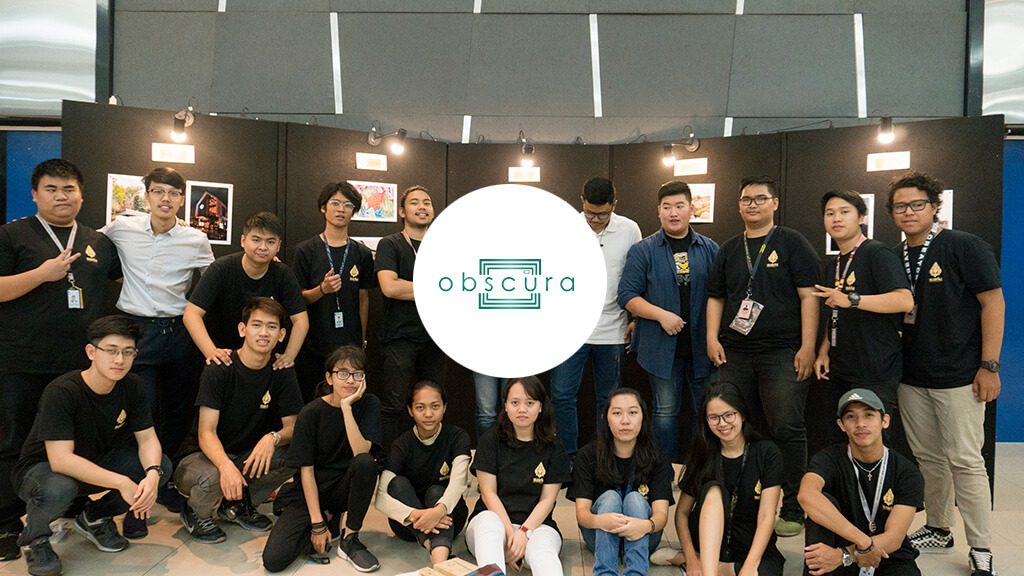
Obscura is a Student Activity Unit (UKM) engaged in photography under the auspices of Universitas […]

SEE OTHER
UMN’S STUDENT ACTIVITIES
Penelitian Hibah DIKTI - TK
Rekapitulasi Hak Cipta Teknik Komputer
Daftar Kegiatan PKM Dosen
Rekapitulasi Inovasi Hak Cipta - Teknik Komputer
CERTIFICATION
Continuing Education Department (CED)
Continuing Education Department (CED) adalah program pengembangan pendidikan di Universitas Multimedia Nusantara (UMN) yang merupakan bagian dari Grup Kompas Gramedia. Kami memiliki berbagai program dalam kursus bahasa, pengembangan manusia, Pusat Pengujian untuk sertifikasi nasional dan internasional, dan program pelatihan. CED UMN dirancang untuk memenuhi kebutuhan siswa sekolah menengah dan perguruan tinggi, serta masyarakat dan profesional.
Information Literacy
Information literacy is an ability that individuals have in determining, searching, managing and evaluating information effectively and efficiently. This training is open to UMN active students. For further information, please contact: library.umn.ac.id
Accreditation Documents
Universitas Multimedia Nusantara (UMN) demonstrates its commitment to quality assurance in education through the availability of accessible accreditation documents for all stakeholders. These documents serve as official evidence of the institution’s and academic programs’ adherence to established quality standards, ensuring that all educational, research, and community service processes meet the national standards set by the National Accreditation Board for Higher Education (BAN-PT) and align with global needs and developments.

SEE MORE DETAILS
During my studies at UMN, I gained a strong foundation of knowledge and fundamental concepts essential for future developments in the field of technology that is applied in the field of work. Moreover, the opportunity to work on real-life projects helped me develop critical thinking when solving a problem.
Dicky Hartono
Computer Engineering UMN, batch 2007 Digital Design and Verification Engineer at Miuren Semiconductor, Shanghai – China
Computer Engineering
“Industry 4.0 demands collaboration from various fields of science. Students must be equipped with broad technological skills such as Software, Hardware, and IT Infrastructure. The Computer Engineering Study Program collaborates the skills of the three technologies so that students are ready to contribute in the industrial and business world.”
Samuel, M.T.I., Head of Computer Engineering Study Program