
PT Surveyor Indonesia (Persero)’s TJSL Program Inaugurates Clean Water Facilities in Carita Village, UMN Ready to Support Sustainable Education
December 11, 2025
UMN and Spectrum UniTec are Both Open to Partnership and Collaboration Opportunities
December 17, 2025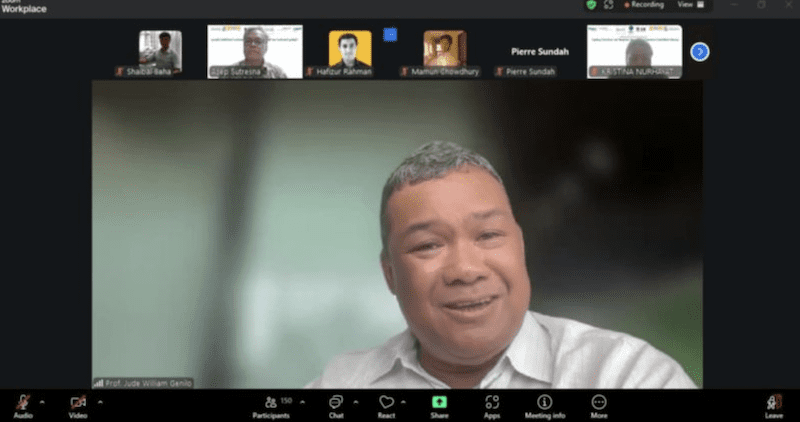
Public Lecturer with Jude held via Zoom (Doc. UMN)
Tangerang, (10/12/2025) – Multimedia Nusantara University held a sharing session titled “Fighting ‘Fake News’ and ‘Deepfake’: How Different Countries Teach Media Literacy” together with University of Liberal Arts Bangladesh and Universiti Sains Malaysia. This sharing session was led by F. X. Lilik Dwi Mardjianto, Ph.D.; Prof. Dr Jamilah Hj Ahmad, APR, FIPR; and Prof Dr. Jude William R. Genilo
In this sharing session, F. X. Lilik Dwi Mardjianto dari Universitas Multimedia Nusantara, Prof Dr. Jude William R. Genilo dari University of Liberal Arts Bangladesh, dan Prof. Dr Jamilah Hj Ahmad, APR, FIPR dari Universiti Sains Malaysia discussed about how threatening fake news and deepfake is nowadays, particularly in the educational setting. They gave their perspective according to their respective countries–Indonesia, Malaysia and Bangladesh.
“We know that we really should not underestimate the urgency to handle fake news and deepfake in the modern days. We need to find the right way to reduce it. Hence, we would like to know each country’s approaches regarding this matter,” said Asep Sutresna, MA, opening the sharing session as a moderator.
Dr. Jude, as a professional that has been pursuing his career in the education field in Bangladesh for seventeen years, said there is not so much difference in Bangladesh compared to the other countries in the context of fighting fake news and deepfake. However, it is challenging to determine who should decide what constitutes harm.
“The determination of what constitutes harm to sentiments is inherently complex and multifaceted. There is no single entity or universal standard that determines this, which creates big challenges in the content moderation landscape. Social media platforms themselves develop their own policies and values to decide what content they consider harmful. However, the challenge intensifies when considering cultural nuances—what might be considered harmful in one cultural context may be acceptable in another,” said Dr. Jude.
Dr. Jude also added that the removal of posts deemed harmful does present genuine tensions with freedom of speech principles. Content moderation systems that rely on rapid takedowns without thorough review will create what has been termed a ‘remove first, review later’ approach, which can suppress legitimate speech. This approach shifts the burden onto users to prove their content is acceptable. In addition, this essentially inverts the principle of ‘innocent until proven guilty’. The concern is particularly acute because automated systems and algorithms used to enforce mass content removal often lack nuanced understanding of context.
“Strategic content moderation involves more nuanced interventions that consider the surrounding context and the user’s intent. Rather than simply removing content, platforms can employ approaches such as restricting visibility of problematic content rather than complete removal,” Dr. Jude added.
Next, Dr. Jamilah explained that Malaysia faces a substantial and growing challenge with fake news and deepfakes. By January 2025, the MCMC had removed 32,436 pieces of online-scam-related content and reported tens of thousands of removals of fake or AI-generated material. Government records show a dramatic increase, where the MCMC had requested 16,110 fake-news removals as of August 1, 2025; compared to 5,367 cases in 2023 and 17,245 in 2024.
“Malaysia’s efforts to manage online content and cybersecurity are led by several key bodies. First, the Malaysian Communications and Multimedia Commission (MCMC) regulates online content, handles takedown requests, and promotes public awareness. The Ministry of Communications and Digital (KKD) sets policy direction against misinformation, using digital forensics and AI/ML tools to detect deepfakes. The National Cyber Security Agency (NACSA), under the Cyber Security Act 2024, strengthens national cyber resilience, coordinates responses to cybercrime, and protects critical infrastructure. These actions are grounded in the Communications and Multimedia Act 1998, particularly Section 233, which governs the misuse of network facilities for harmful or false content,” explained Dr. Jamilah regarding to each key body’s role.
Third, Lilik shared that in Indonesia, we are too focused on information literacy instead of media literacy. Information literacy focuses on the ability to identify information needs, locate information sources, evaluate their credibility and reliability, and use information effectively to solve problems. While media literacy, by contrast, emphasizes understanding, analyzing, and evaluating media messages and content across various formats including texts, images, audio, and video.
“Indonesia’s focus on information literacy rather than media literacy appears to stem from a practical, skills-centered approach to combating misinformation. The concern raised by Indonesian scholars is focusing primarily on information literacy. A broader media literacy approach would also examine who produces content, what the motive is, and how strong the evidence supports it. Hence, researchers at Indonesian universities have emphasized that digital literacy must go hand-in-hand with critical thinking skills that encourage learners to continuously question information,” said Lilik.
Lilik also hopes, by emphasizing the ability to locate, evaluate, and use information ethically across all contexts, Indonesia will be able address both traditional media literacy concerns and the broader challenge of navigating an information-rich digital ecosystem.
Asep took the session over after the three speakers all shared their perspective and summarized it. The sharing session ended with a Q&A forum, where the participants showed their enthusiasm which the speakers were grateful for.
By Tangika Valencia | UMN News Service
English Translation by Tangika Valencia
Kuliah di Jakarta untuk jurusan program studi Informatika| Sistem Informasi | Teknik Komputer | Teknik Elektro | Teknik Fisika | Akuntansi | Manajemen| Komunikasi Strategis | Jurnalistik | Desain Komunikasi Visual | Film dan Animasi | Arsitektur | D3 Perhotelan , di Universitas Multimedia Nusantara.